
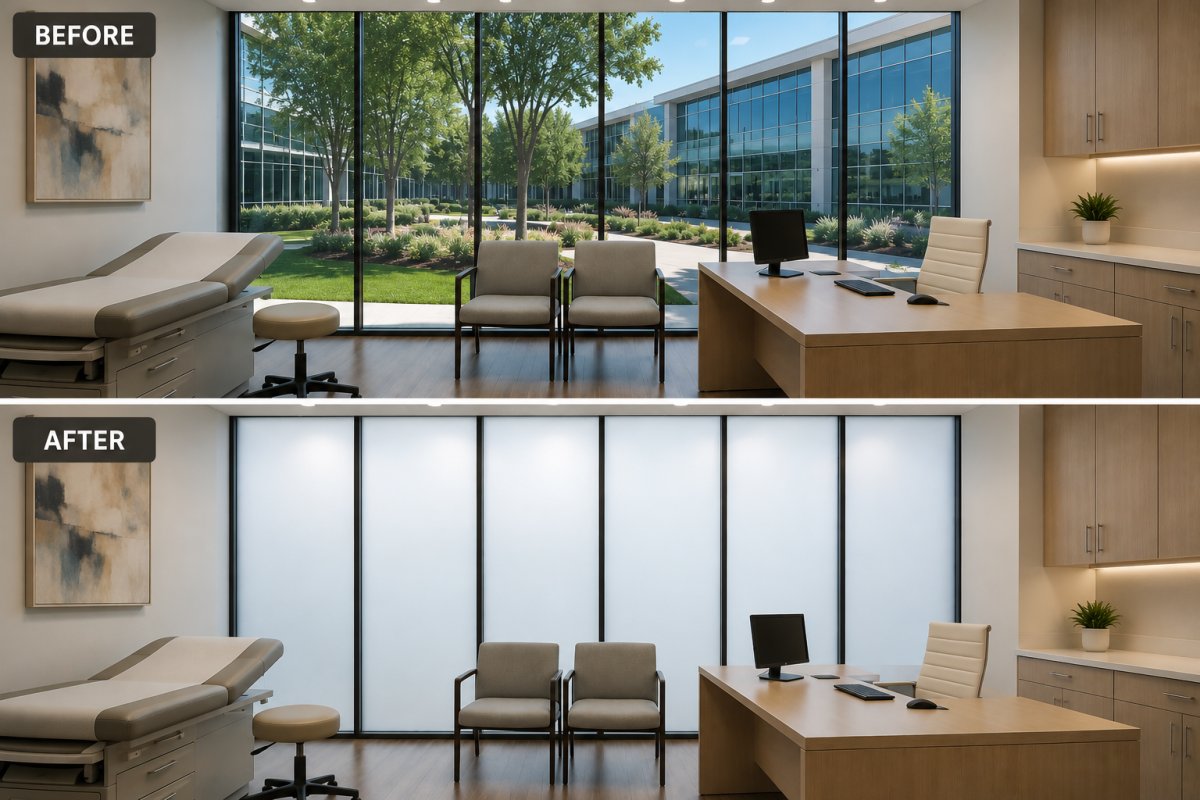
Milwaukee-area clinics are under growing pressure to tighten visual privacy, meet HIPAA standards, and keep infection rates low without disrupting daily patient flow. Traditional window blinds were never designed for clinical environments. They collect dust, harbor pathogens, and require constant maintenance, pulling staff away from patient care.
The switchable privacy film in Milwaukee healthcare facilities is a smarter, cleaner, and more compliant alternative. MGT Glass Solutions installs PDLC-based smart film across Milwaukee, Wauwatosa, Brookfield, Glendale, Shorewood, and surrounding suburbs, helping specialty practices and medical office buildings modernize their privacy infrastructure without replacing glass.
Why Clinics Are Phasing Out Blinds
Blinds have been a default fixture in exam rooms for decades, but the clinical case against them has grown hard to ignore.
Fabric, vinyl, and horizontal slat blinds are porous surfaces. In a healthcare setting, porous surfaces are a liability. They trap airborne particles, absorb splatter, and require disassembly for proper cleaning. Infection control teams know that blinds rarely get the deep cleaning they need, especially in high-turnover exam rooms.
Beyond hygiene, blinds create operational friction. Cords break. Slats bend. Mechanisms jam at the worst possible moments. Staff manually adjusting blinds between patients adds seconds and mental load to an already stretched workflow. And when a cord is pulled too hard in front of a patient, it signals a low-quality environment, exactly the opposite of what modern practices want to project.
Visual privacy is also a compliance issue. The HIPAA Privacy Rule requires covered entities to protect patients from unauthorized disclosure of protected health information, including what can be seen through a window or glass partition. Blinds that are broken, improperly adjusted, or simply inadequate for the room’s sightlines create real exposure.
Milwaukee clinics that have switched to switchable privacy film report fewer maintenance calls, cleaner infection audits, and better patient satisfaction scores. The shift is practical, not cosmetic.
How Switchable (PDLC) Film Works in Clinical Settings
 PDLC stands for Polymer Dispersed Liquid Crystal. It is the core technology behind switchable smart film. Understanding how it works helps clinical administrators make informed purchasing decisions.
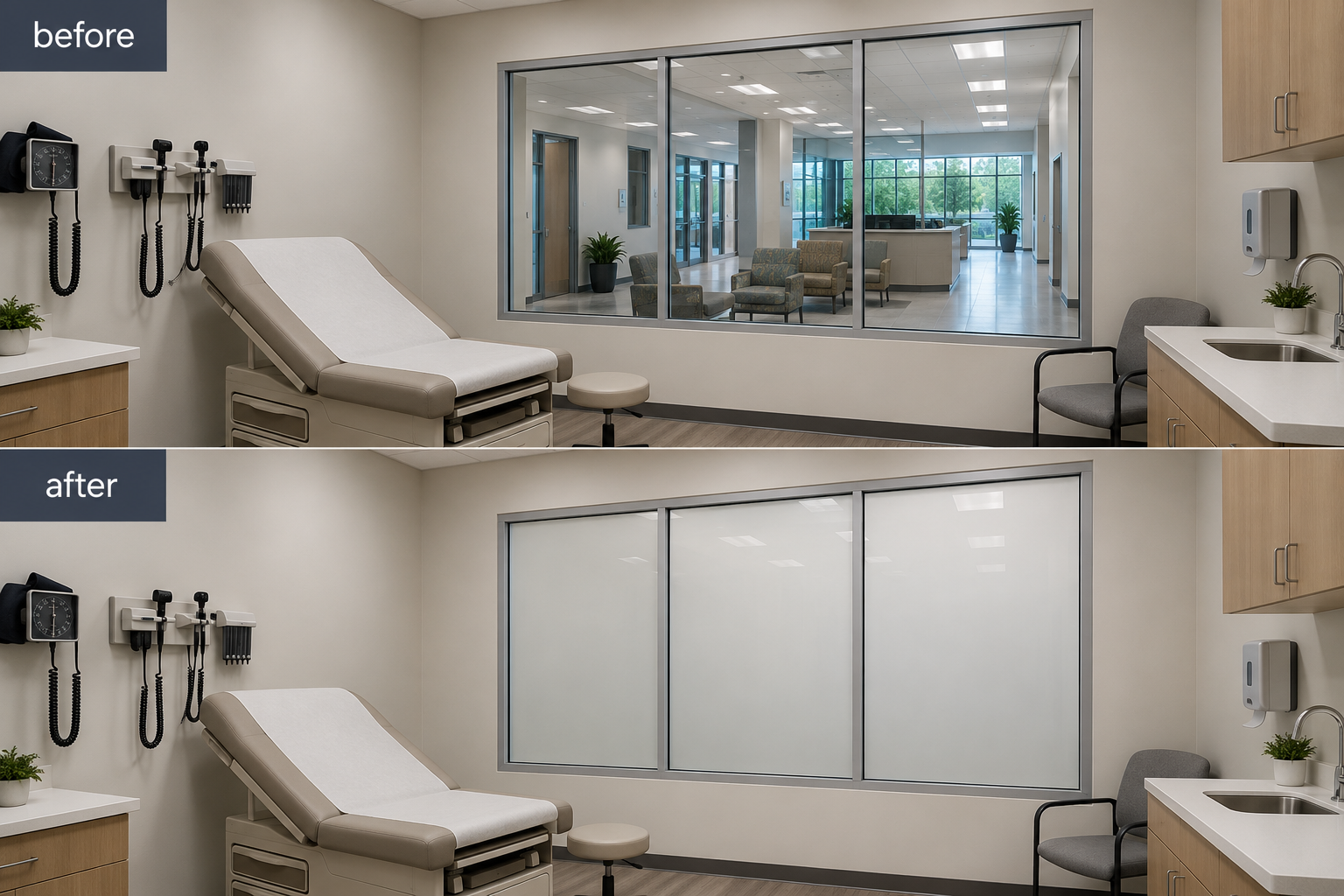
At rest, without an electric current, the liquid crystals in the film are randomly oriented. Light scatters as it passes through them, and the glass appears opaque white. This is the default privacy state. When a low-voltage current is applied, the crystals align, and the film becomes transparent, allowing full visibility through the glass.
In a clinic exam room, this means the occupant or staff member controls privacy via a wall switch, a toggle, or an integrated building-automation command. There are no cords, no moving parts, and no manual adjustment required. The transition takes less than a second.
PDLC film is applied directly to existing glass surfaces, similar to commercial window film solutions used in office buildings and retail environments. It bonds to the glass, forming a smooth, flat surface on the interior side of the pane. That surface can be wiped down with standard clinical disinfectants without damaging the film.
For a deeper overview of the technology and how it performs across different environments, see this guide on how switchable privacy film works.
HIPAA, Infection Control, and Patient Experience
Three pressures are converging on Milwaukee healthcare facilities right now, and switchable film addresses all three directly.
HIPAA and visual privacy compliance. The HIPAA Privacy Rule does not specify how visual privacy must be achieved, but it does require that practices implement reasonable safeguards. Switchable film provides instant, reliable, and consistent privacy that does not depend on staff remembering to close blinds or adjust curtains. When the film is off, it is fully opaque. There is no partial coverage, no edge gap, and no variation in transparency. That consistency is what compliance requires.
Infection control. The flat, non-porous surface of installed PDLC film is compatible with EPA-registered hospital disinfectants, including quaternary ammonium compounds, hydrogen peroxide-based solutions, and alcohol wipes used in clinical settings. There are no slats, cords, brackets, or fabric surfaces for pathogens to accumulate on. During infection control audits, switchable film-equipped rooms consistently outperform rooms with traditional window coverings.
Patient experience. Patients notice their environment. A room that feels controlled, clean, and intentional builds trust. Switchable glass creates a modern, professional impression that aligns with the standard of care the practice is delivering. It also removes the awkward moment when a patient watches a staff member fumbling with a blind while waiting for an exam to begin.
For Milwaukee specialty practices competing for patient loyalty, the patient-experience dimension of smart film is increasingly a key differentiator.
Applications: Exam Rooms, Procedure Rooms, Executive Offices
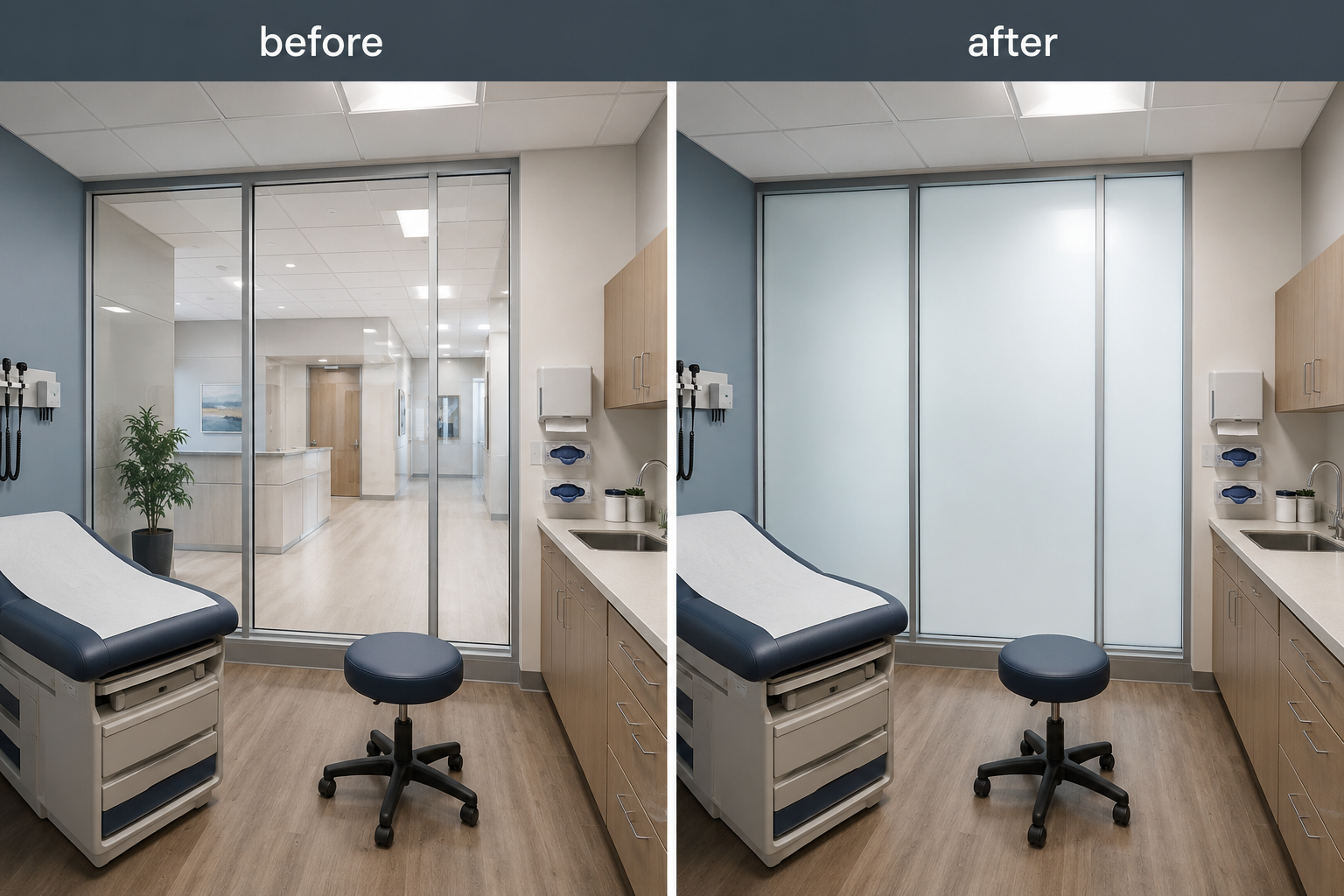 Switchable film is not a single-use product. Milwaukee healthcare facilities are applying it across multiple zones within the same building.
Exam rooms. This is the highest-volume application. Switchable film on exam room sidelites and interior glass partitions gives patients instant privacy while keeping the room easy to monitor from the hallway when unoccupied.
Procedure rooms. In dermatology, orthopedics, gastroenterology, and surgical suites, procedure rooms require more reliable privacy than exam rooms and are subject to higher infection-control expectations. Smart film meets both requirements and can be integrated with room status lighting systems.
Consultation rooms. Sensitive conversations around diagnoses, treatment plans, and billing happen in these spaces. Switchable film on glass walls or interior windows keeps those conversations visually private without requiring a fully enclosed, windowless room.
Executive and administrative offices. Medical office buildings in Wauwatosa, Brookfield, and downtown Milwaukee are using smart film in leadership suites and HR areas where confidential discussions occur, while still allowing natural light.
Waiting area partitions. Some practices use smart film on glass partitions adjacent to reception desks to manage visual privacy for patients checking in or discussing insurance information.
Each of these applications uses the same PDLC film that Milwaukee medical office smart film installations run on, scalable from a single exam room to an entire multi-floor facility.
Installation in Occupied Milwaukee Clinics
One of the most common concerns from clinic administrators is downtime. Healthcare facilities cannot shut down for days during a renovation. MGT Glass Solutions has developed an installation process specifically designed for occupied clinical environments.
Pre-installation assessment. Before any work begins, our team conducts a site visit to document glass dimensions, assess existing surface conditions, map electrical access points, and identify any exam rooms that need to remain fully operational on specific days.
Phased scheduling. Installation is scheduled room by room or zone by zone, working around the clinic’s appointment schedule. Most single-room installations are completed within two to four hours. A full wing or floor can be sequenced across multiple visits without interrupting patient care in other areas.
Low-disruption process. PDLC film installation does not require demolition, glass removal, or heavy equipment. The process involves surface cleaning, film application, edge sealing, and wiring to a low-voltage switch or existing building controls. Rooms are typically available for patient use the same day.
Post-installation walkthrough. MGT provides a full demonstration and handoff to facility staff, covering cleaning protocols, switch operation, and warranty support.
Milwaukee-area clinics in Glendale, Shorewood, West Allis, Menomonee Falls, and Oak Creek have completed installations with zero patient care interruptions.
Request a Milwaukee Site Visit
If your clinic is evaluating switchable film for exam rooms, procedure spaces, or any glass partition in your facility, the first step is a no-obligation site visit from MGT Glass Solutions.
During the visit, we will measure your glass surfaces, discuss your privacy and compliance goals, review your infection control protocols, and provide a detailed proposal with transparent pricing. There is no commitment required and no sales pressure.
MGT Glass Solutions serves Milwaukee, Wauwatosa, Brookfield, Glendale, Shorewood, West Allis, Menomonee Falls, Oak Creek, Franklin, and surrounding communities. Our team understands the operational realities of active medical practices and works around your schedule.
Contact MGT Glass Solutions to schedule your healthcare site visit in Milwaukee.
Frequently Asked Questions
Can switchable film be installed on existing clinic glass?
Yes. PDLC film can be applied directly to existing glass surfaces without requiring replacement. As long as the glass is in good condition and free of previous film or coatings that would interfere with adhesion, installation is straightforward. MGT assesses all surfaces during the initial site visit to confirm compatibility before any work begins.
Is Smart Film easy to clean and disinfect in a clinical setting?
Yes. Installed PDLC film creates a smooth, non-porous surface compatible with hospital-grade disinfectants commonly used in clinical environments, including alcohol-based wipes, quaternary ammonium cleaners, and hydrogen peroxide solutions. It requires no special cleaning protocol beyond what staff are already using on other hard surfaces in the room.
Does it fail clear or opaque when the power is off?
The switchable film is not opaque. Without electrical current, the liquid crystals return to their default random orientation, scattering light and creating a white, frosted appearance. This is the safer default for a healthcare setting, ensuring privacy is maintained during a power interruption rather than exposing the room.
How does the cost compare to the cost of switchable glass replacement?
Switchable film typically costs 60 to 80 percent less than replacing existing glass with factory-built smart glass units. Because the film installs onto existing glass, there is no structural modification, no glass disposal cost, and no extended downtime. For clinics with multiple exam rooms, the difference in total project cost is substantial. MGT provides itemized quotes so administrators can make a direct comparison.
“`