
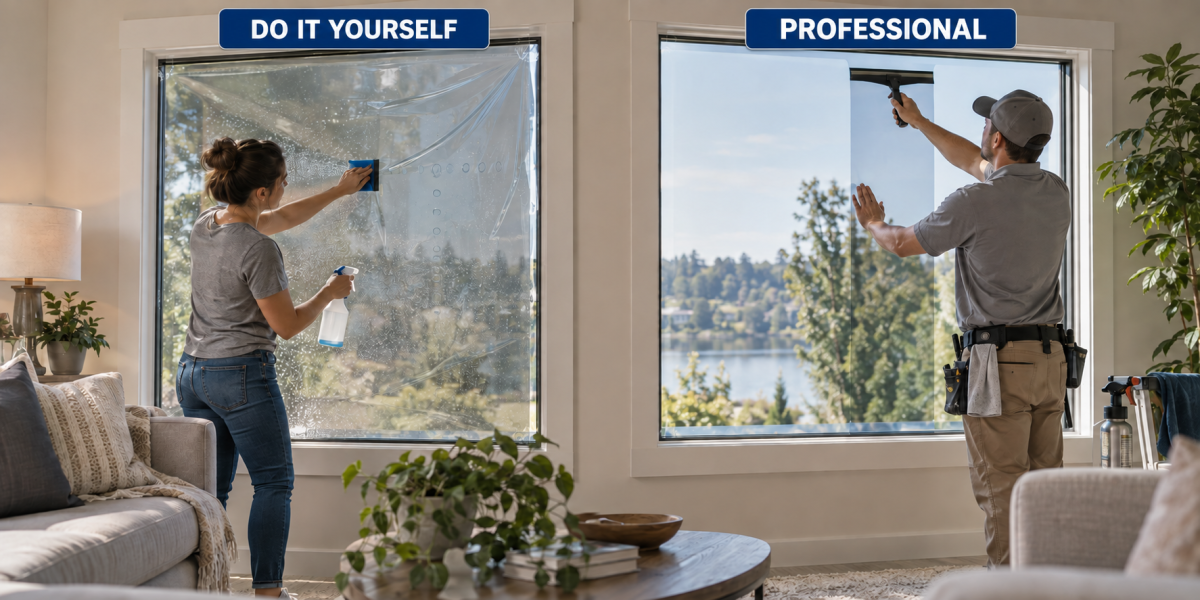
DIY Window Film vs. Professional Installation: Does It Depend on the Film?
The honest answer to whether you should install window film yourself or hire a professional depends heavily on which film you’re actually installing, not a universal yes or no. A basic privacy film mistake on a single window is a minor, fixable annoyance. A botched attempt at ceramic or security film on an expensive piece of glass is a genuinely costly mistake, both in wasted material and potential glass damage.
Most comparisons treat this as a single question with a single answer. In practice, the risk and cost calculation changes significantly depending on the film category. This guide organizes the decision around that risk, rather than a flat DIY-versus-professional feature list, so you can match the right approach to the specific film you’re considering.
Key Takeaways
- The right choice between DIY and professional installation depends heavily on the specific film type, not a universal answer.
- Basic privacy or standard solar film carries relatively low risk if a DIY attempt doesn’t go perfectly.
- Ceramic, high-performance solar, and security films carry higher stakes, since mistakes are more expensive and harder to correct.
- A failed DIY attempt on premium film often costs more in wasted material and redo labor than professional installation would have cost from the start.
- Many manufacturer warranties require professional installation for full coverage, particularly on higher-end film lines.
The Short Answer
Whether DIY or professional installation makes more sense depends on the specific film type: basic privacy or standard solar film is a reasonable DIY candidate, while ceramic, high-performance, and security film carry higher stakes that generally favor professional installation. Most comparisons mistake this for a single, universal decision rather than one that depends on what you’re actually installing.
Why the Right Answer Depends on Which Film You’re Installing
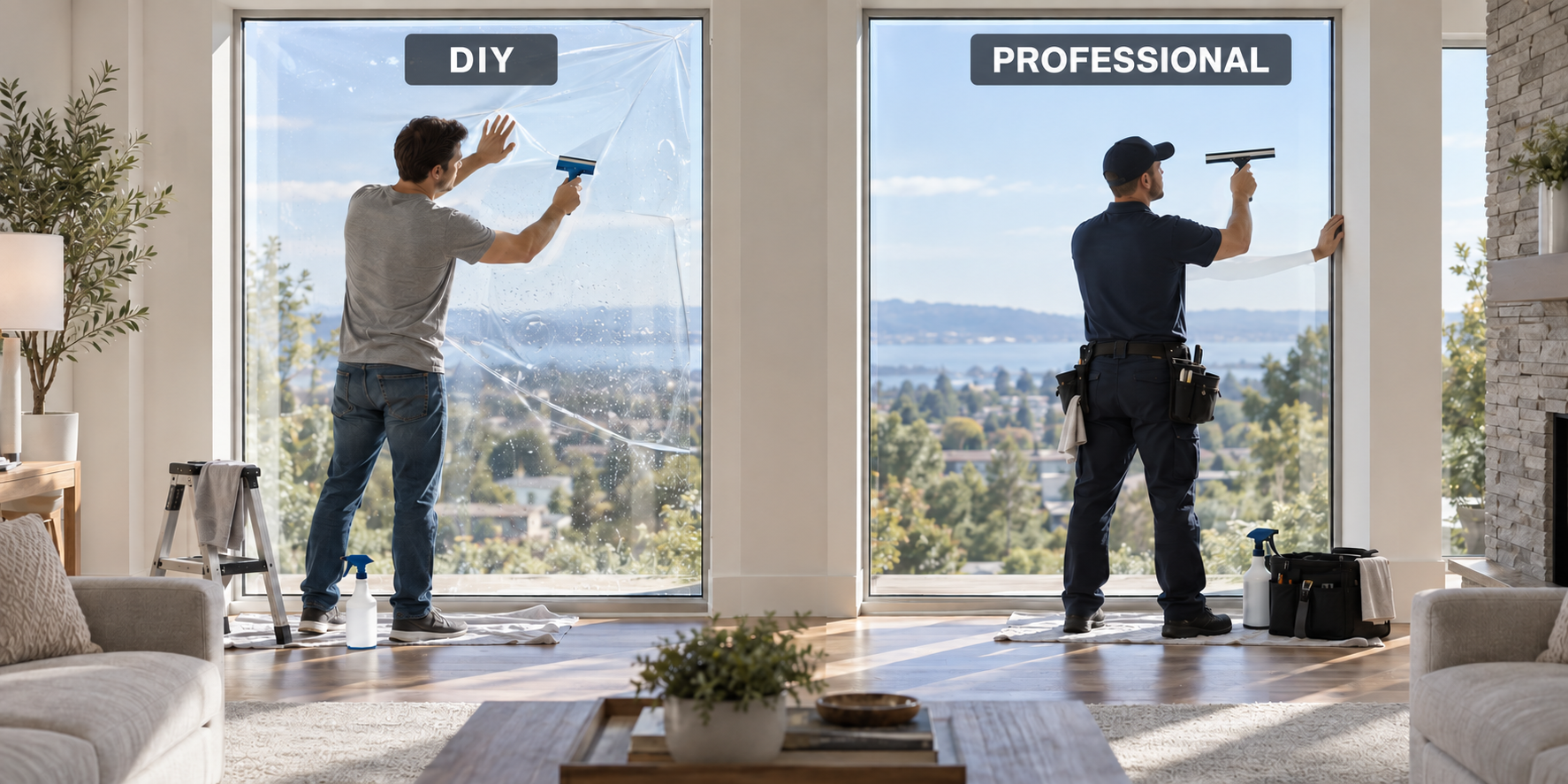 Not all window film is engineered the same way, and that difference matters more for installation risk than most people realize. Basic dyed or standard privacy film tends to be more forgiving of minor application imperfections, since the material itself is simpler and the visual result of a small mistake is usually just cosmetic.
Ceramic and multilayer performance films use more precise, sometimes more delicate coatings that are less forgiving of dust contamination, bubbling, or improper surface preparation. Security and safety film adds another layer of complexity, since its entire function depends on a strong, correctly executed adhesive bond to the glass and frame, not just a smooth cosmetic finish.
Think of this as a spectrum rather than a binary choice. On one end, an inexpensive roll of basic privacy film on a single bathroom window carries almost no real risk if the first attempt isn’t perfect. On the other end, a large ceramic film installation on an expensive architectural window, or a security film project meant to resist forced entry, genuinely carries real financial and functional consequences if something goes wrong. Most homeowners’ actual projects fall somewhere between these two extremes, which is exactly why a single blanket answer doesn’t serve most readers well.
Film Categories Where DIY Is a Reasonable Risk
Basic privacy film, standard dyed solar film, and simple static-cling products are generally reasonable DIY candidates, especially for a single window or a low-visibility area. The materials are inexpensive relative to premium film lines, the application process is more forgiving of minor technique issues, and the consequences of an imperfect result are mostly cosmetic rather than functional. If a first attempt doesn’t go perfectly, the cost of buying more basic film and trying again is relatively low.
Film Categories Where Professional Installation Matters Most
Ceramic and high-performance solar film represent a meaningfully higher-stakes category. These products often cost significantly more per square foot than basic film, and their performance depends on a clean, bubble-free, properly bonded application, which is harder to achieve without experience and the right tools. Should you install 3M window tint films yourself? This specific comparison covers this topic in more depth for premium 3M film lines.
Security and safety film sits in its own category entirely. Because its function depends on a strong adhesive bond and, in some cases, proper anchoring to the window frame, an imperfect DIY installation doesn’t just look worse; it can genuinely underperform in the very function the product is meant to provide. This is also true for large commercial glass panels, where the project’s scale and the cost of the glass itself raise the stakes of any installation mistake.
Tools and Technique Requirements Scale With Film Complexity
Basic film installation typically requires only a spray bottle, a squeegee, and a utility knife, tools most homeowners already have or can buy inexpensively. Ceramic and high-performance films often benefit from specialized tools, including precision cutting equipment and application techniques designed to avoid trapping dust or air beneath a more sensitive coating layer. Security film installation frequently requires additional equipment, such as anchoring systems or specialized adhesives, to secure the film to the window frame rather than just the glass surface. This escalation in tooling and technique requirements tracks closely with the escalation in risk across film categories, which is part of why the DIY-versus-professional calculation shifts so significantly depending on what’s actually being installed.
The Real Cost of a Failed DIY Attempt
The upfront cost comparison between DIY and professional installation often looks favorable to DIY, since materials alone are cheaper than paying for labor and expertise. That comparison changes once a DIY attempt doesn’t go as planned. You must replace wasted film, erasing some or all of the initial savings. If the failed attempt also damages the glass itself, through scratching from improper tool use or adhesive residue that requires aggressive cleaning, the total cost of the redo can end up higher than professional installation would have been from the start. This risk scales directly with the cost of the film and the glass involved, which is exactly why the calculation looks different for an inexpensive roll of basic film versus a premium ceramic or security product.
Warranty Considerations by Film Type
Many window film manufacturers, particularly for premium and performance-oriented product lines, require professional installation for full warranty coverage. DIY installation on these products can limit or void that protection entirely, which matters more the more expensive the film is in the first place. According to the International Window Film Association, installation complexity and quality requirements vary significantly across film categories, which is part of why manufacturers structure warranty terms differently by product line rather than applying a single blanket policy across their entire catalog. Checking a specific product’s warranty terms before deciding on DIY installation is a reasonable step regardless of which film category you’re considering.
Comparison Table
| Film Category | DIY Risk Level | Typical Warranty Requirement | Recommended Approach |
| Basic privacy or dyed film | Low | Often flexible on installation method | DIY reasonable for small projects |
| Standard solar control film | Low to moderate | Varies by manufacturer | DIY reasonable with care |
| Ceramic or high-performance film | Moderate to high | Frequently requires professional installation | Professional installation recommended |
| Security or safety film | High | Typically requires professional installation | Professional installation strongly recommended |
| Large commercial glass, any film type | High | Often requires professional installation | Professional installation strongly recommended |
Conclusion
DIY versus professional window film installation isn’t a single decision with one right answer. It should change based on the film category, its cost, its complexity, and the cost of fixing a mistake. Basic privacy or standard solar film remains a reasonable DIY project for many homeowners.
Ceramic, high-performance, and security films raise the stakes enough that professional installation is generally the more sound choice, both for immediate results and for preserving manufacturer warranty coverage. Matching the decision to the specific film, rather than applying one rule to every project, leads to the right outcome.
Frequently Asked Questions
Is DIY installation ever a bad idea even for basic film?
It’s rarely a bad idea for basic film specifically, though a first attempt may take longer or look slightly less polished than a professional installation. The stakes are simply lower if something doesn’t go perfectly.
Why does ceramic film require more installation precision than basic film?
Ceramic film’s coating and performance characteristics are more sensitive to dust, bubbling, and improper surface preparation than simpler dyed film, which makes technique and experience matter more for a clean, functional result.
Does DIY installation always void the manufacturer’s warranty?
Not always, but many premium and performance-oriented film lines do require professional installation for full warranty coverage. Check the specific product’s warranty terms before installing, regardless of film type.
How much more expensive is professional installation compared to DIY?
Professional installation costs more upfront because of labor and expertise, but that gap narrows or reverses if a DIY attempt requires a costly redo, especially with more expensive film categories.
Is security film installation really that different from standard film?
Yes. Security film’s function depends on a strong adhesive bond and sometimes proper frame anchoring, so installation quality directly affects whether the product performs as intended, not just how it looks.
Should I attempt DIY installation on a large commercial window?
Generally not recommended. Large commercial glass significantly increases the cost of any mistake, and professional installation is usually the better approach, regardless of the specific film type used.
Can I start with a DIY basic film project to see if I want to try more advanced film later?
Yes, this is a reasonable way to build comfort with the process before considering a DIY attempt on a more complex or expensive film category, if that’s something you’re considering.
What’s the biggest mistake people make when deciding between DIY and professional installation?
The most common oversight is treating it as a single, universal decision rather than evaluating the specific film type, its cost, and the cost of a failed attempt to fix it.
Do I need special tools for ceramic or high-performance film that I wouldn’t need for basic film?
Often yes. Ceramic and performance film applications benefit from more precise cutting tools and dust-control techniques than basic film typically requires, which is part of why experience matters more for this category.
Is it ever worth hiring a professional for basic privacy film if the stakes are low?
It can still be worth it if you want a faster, more polished result or simply don’t want to spend a weekend on the project, even though the financial risk of DIY is low in this category.
Not Sure Which Approach Fits Your Project?
Whether you’re considering a basic DIY project or a premium film installation where professional expertise matters more, contact MGT to talk through which approach fits your specific film and glass.