
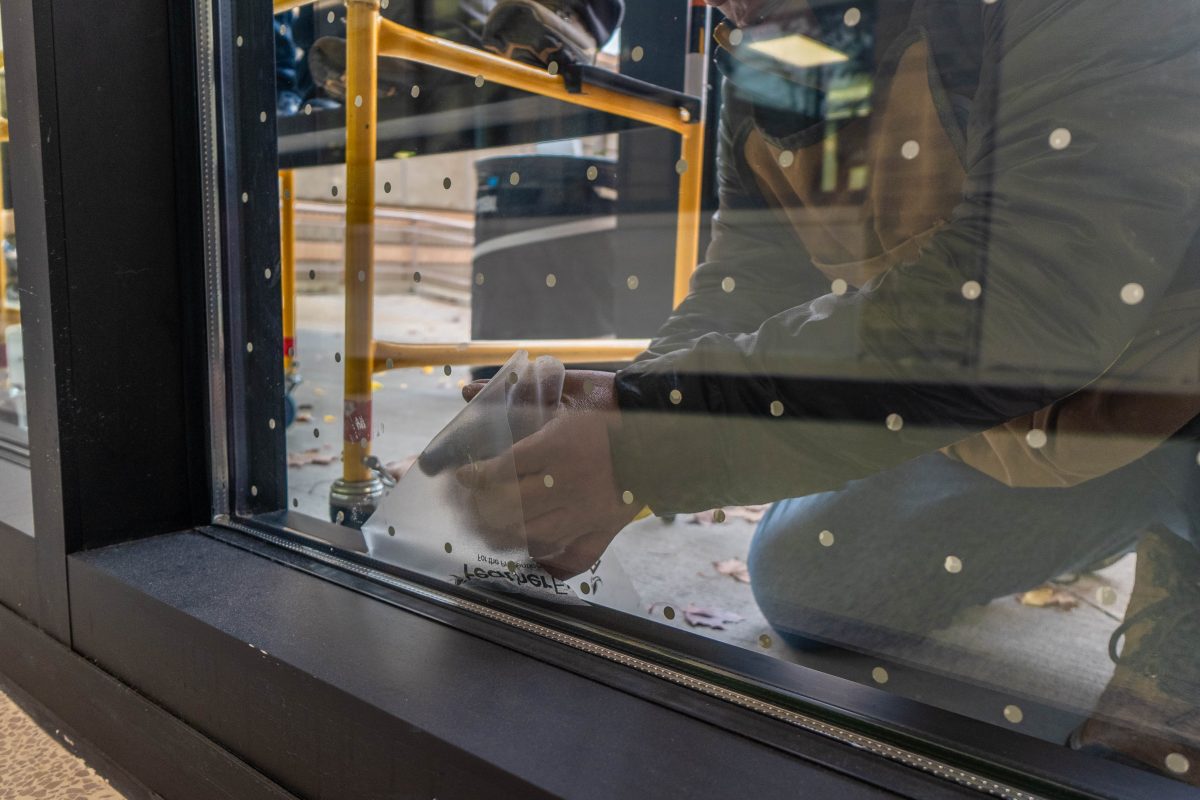
Chicago sits directly on the Mississippi Flyway, one of the busiest migratory corridors in North America. When hundreds of millions of birds move through the region each spring and fall, the city’s reflective glass towers and lakefront campus buildings become invisible hazards. Bird-deterrent window film in Chicago gives property managers and sustainability leads a practical, code-compliant way to reduce collisions without replacing glass or compromising views.
Bird collision window film, specifically feather-friendly patterned film, is now one of the most cost-effective compliance tools available to Chicago architects, sustainability officers, and facilities teams. It supports LEED Pilot Credit 55 requirements, aligns with Lights Out Chicago goals, and can be applied to existing glass without major retrofits. This article covers how the film works, which property types benefit most, and what installation looks like on an occupied commercial campus.
Why Chicago Has One of the Highest Bird-Strike Rates in the U.S.
Chicago is routinely ranked among the most dangerous cities in the country for migratory birds. The Chicago Bird Collision Monitors, a volunteer monitoring organization, has documented tens of thousands of strikes in the urban core over the past two decades. Three factors combine to make the Chicago market especially high-risk.
- Flyway position. The Mississippi Flyway channels birds directly over the Chicago metro. In peak migration windows, typically April through May and August through October, nightly bird movement through the city is measured in the millions.
- Lakefront glass concentration. The density of reflective curtain-wall buildings along Lake Michigan creates a corridor where birds cannot distinguish reflected sky and vegetation from open space.
- Suburban campus sprawl. Low-rise corporate campuses in the suburbs, particularly those with floor-to-ceiling glazing adjacent to landscaped grounds or retention ponds, account for a significant share of documented strikes. The glass height and proximity to natural habitat make them especially problematic.
The Lights Out Chicago program, run through the Field Museum and supported by the City of Chicago, works to reduce building light emissions during migration periods. Bird-safe glazing is increasingly framed as the structural complement to that effort.
How Bird Deterrent (Feather-Friendly) Film Works
 Most people assume birds collide with glass because it’s clear. That’s only part of it. The bigger issue is that birds can’t process reflections as reflections. When glass mirrors a tree line or open sky, a bird in flight treats it as a clear path. The fix isn’t to obscure the glass entirely. It’s to add a pattern that birds can register as a solid barrier.
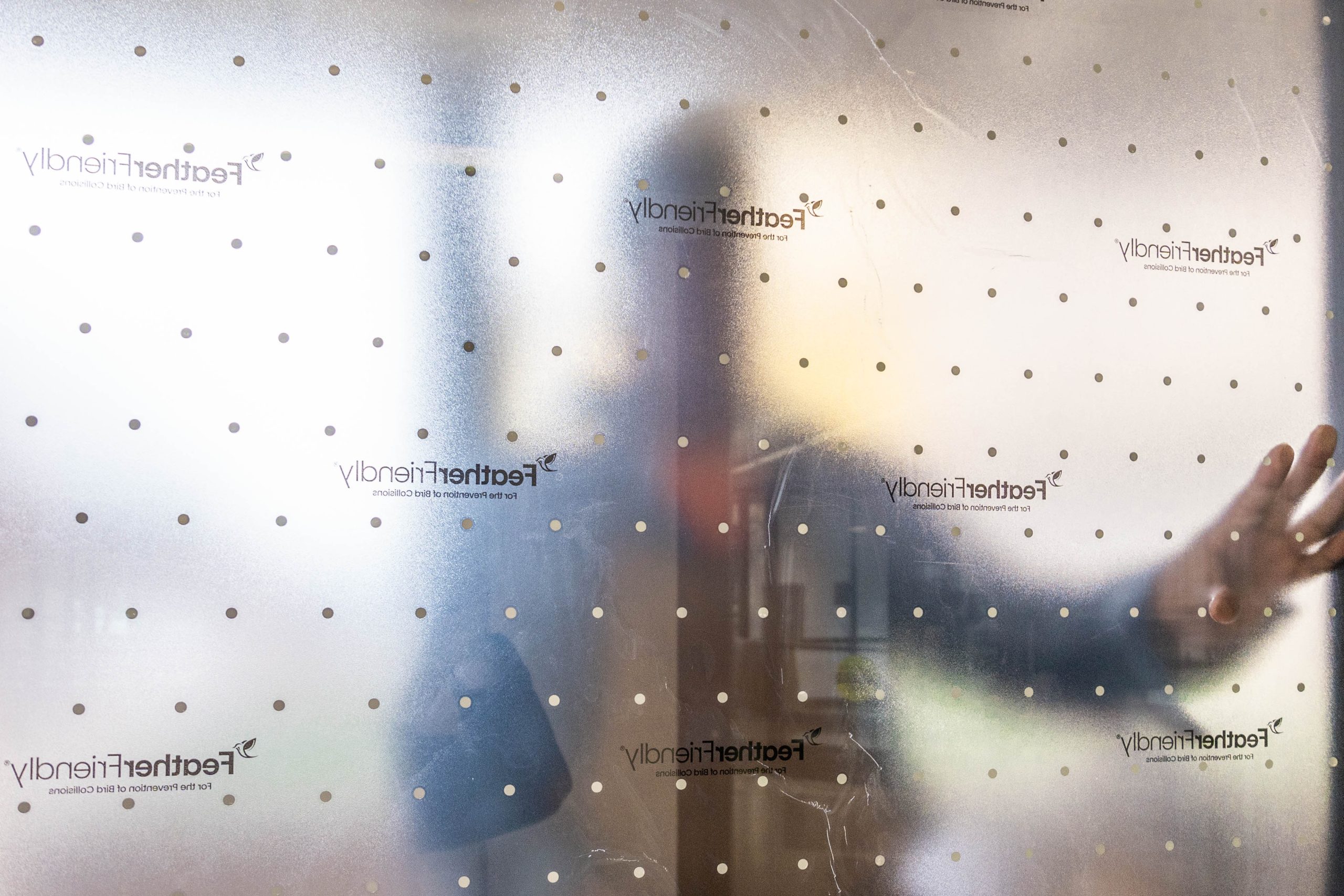
That’s what feather-friendly film does. It applies a repeating dot or line pattern to the glass surface at a specific spacing that birds see as an obstacle. The pattern is subtle enough that people inside the building barely notice it, but visible enough in the UV spectrum that birds detect it from a distance and redirect their course.
Visual Markers Birds Actually See
The American Bird Conservancy guidelines specify a maximum spacing of 2 inches horizontal by 4 inches vertical for external markers. Within those parameters, a range of dot patterns, fritted designs, and UV-reflective coatings has been validated. Feather-friendly film meets or exceeds these specifications.
For a closer look at how feather-friendly markers prevent bird strikes at the product level, the pattern geometry and installation tolerances are documented in detail. The short version: the markers work because they’re spaced correctly, not because they’re large or opaque.
Exterior vs. Interior Application
Exterior application is more effective. The marker pattern faces the bird directly, unaffected by what’s happening on the interior side of the glass. It’s also more durable in most scenarios when the film is rated for external use.
Interior application is a viable option when exterior access is difficult, such as on high-rise curtain walls or in buildings with complex facade geometry. The tradeoff is that reflective glass can partially cancel interior-applied markers, so product selection matters more on the interior side.
MGT Glass Solutions evaluates each elevation separately. What works on a ground-floor atrium wall may not be the right call on a fifth-floor reflective curtain wall facing a wooded buffer.
LEED, Lights Out Chicago & Compliance Drivers
LEED Pilot Credit 55, Bird Collision Deterrence, offers points toward LEED certification for projects that use compliant glazing strategies. The credit applies to both new construction and existing buildings pursuing LEED Operations + Maintenance recertification. Feather-friendly film is one of the approved strategies.
For teams actively managing a LEED O+M scorecard, bird-safe glazing represents a relatively accessible credit. The film installation generates documentation for the credit submission, including product spec sheets and installation coverage records.
Beyond LEED, the Lights Out Chicago program creates organizational pressure that’s increasingly showing up in tenant ESG reporting and building certification renewals. Facilities leads at campuses in the Streeterville, River North, and Fulton Market corridors are hearing about it from tenants and property management companies alike.
There’s no Chicago ordinance currently mandating bird-safe glazing for existing buildings, but Cook County and several suburban municipalities have signaled interest in future requirements. Installing now positions a property ahead of that curve.
Best Candidate Properties in the Chicago Market
Not every building needs the same level of attention. Based on strike documentation and glazing type, the highest-priority properties in the Chicago metro tend to share a few characteristics.
- Suburban corporate campuses with floor-to-ceiling glass adjacent to green space, ponds, or tree buffers.
- Mid-rise buildings in the 2 to 10 story range along the lakefront or near Forest Preserves in DuPage, Lake, or Cook County.
- Healthcare and university campuses with extensive glazing and grounds that attract bird activity.
- Class A office buildings pursuing LEED recertification or responding to tenant sustainability requirements.
The pattern isn’t limited to downtown Chicago. Properties in Evanston, Schaumburg, Oak Brook, and Naperville have similar strike exposure, particularly where developed parcels border undeveloped or natural land.
Installation Planning for Occupied Campuses
 Most facilities leads want to know one thing: how disruptive is this? The honest answer is less than most people expect, but it requires some coordination.
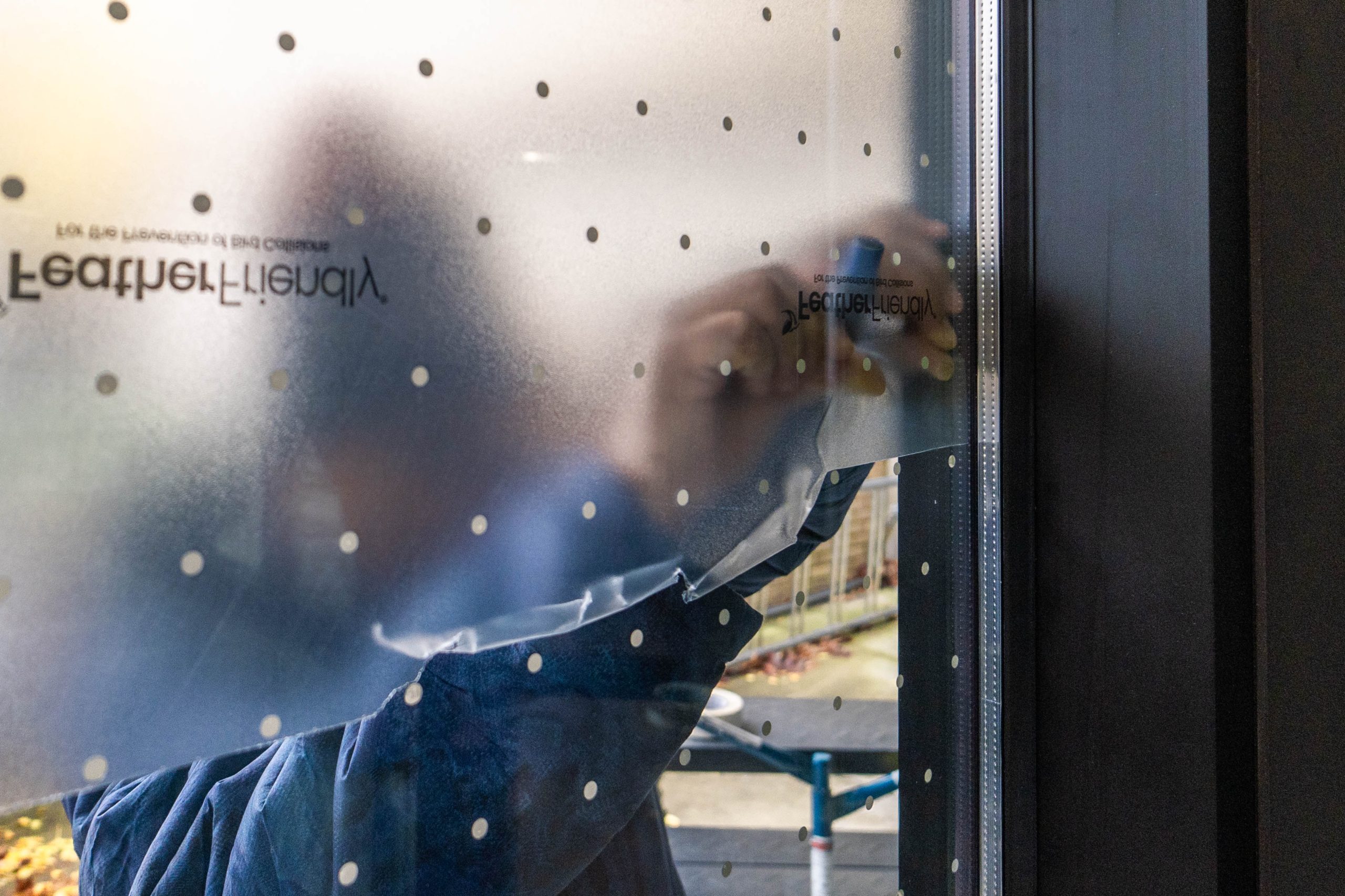
MGT’s team handles the work in-house. No subcontractors. The same crews that assess the building install the film. That matters because commercial window film solutions on occupied buildings require a level of planning and site communication that changes with every subcontractor rotation. Consistent crews mean consistent outcomes.
A typical campus installation is phased by elevation or building section. Ground-floor glazing and high-traffic facades are usually prioritized first. Interior work can often proceed during normal business hours. Exterior lifts or swing-stage access is scheduled around tenant operations and building management preferences.
The film itself carries a manufacturer-backed warranty. On exterior applications, this typically covers a 10-year performance period. Documentation is provided for LEED submissions and property records.
Frequently Asked Questions
Does feather-friendly film affect the view from inside the building?
Not in any meaningful way. The dot pattern used in feather-friendly film is small and spaced widely enough that most occupants stop noticing it within a few days. View clarity and visible light transmission remain largely unchanged. People who sit near the glass occasionally notice a slight texture, but it doesn’t obstruct sightlines or create a frosted effect.
Is bird deterrent film required for any Chicago commercial properties?
There is currently no Chicago ordinance mandating bird-safe glazing on existing commercial buildings. However, LEED Pilot Credit 55 provides a documented path toward certification points, and some new construction projects in Cook County have voluntarily incorporated bird-safe glass specifications or have done so as part of municipal permitting discussions. Requirements may expand in the coming years.
Can existing solar control film be combined with bird-safe markings?
Yes, in many cases. If solar control film is already installed on the interior side of the glass, bird-deterrent markers can often be applied to the exterior. The two films serve different functions and are applied to different surfaces. MGT evaluates existing film specifications before recommending a combined approach to ensure compatibility and confirm the exterior marker pattern will perform as intended.
How long does bird deterrent film last on Chicago exterior glass?
Quality exterior-rated bird deterrent film carries a manufacturer’s warranty of approximately 10 years. Chicago’s climate, including UV exposure, freeze-thaw cycles, and lakefront humidity, is a factor in product selection. MGT specifies films rated for northern climate exterior use to ensure the warranty holds under actual local conditions.
Request a Site Assessment
MGT Glass Solutions has been providing commercial glass and film services in the Chicago area since 1979. That kind of tenure means the team has worked on just about every building type in the market, including high-rise curtain walls, suburban campuses, healthcare facilities, and university buildings, and understands what each requires.
Bird deterrent window film installation is handled entirely in-house. No subcontractors. The same experienced team that assesses your property completes the work, and a manufacturer’s warranty backs every installation. For properties pursuing LEED Pilot Credit 55 or building a response to Lights Out Chicago goals, MGT provides the documentation your sustainability team needs.
Contact MGT Glass Solutions today to schedule a site assessment and learn how bird deterrent window film can reduce collision risk, support your sustainability objectives, and protect the natural environment around your Chicago-area campus.